
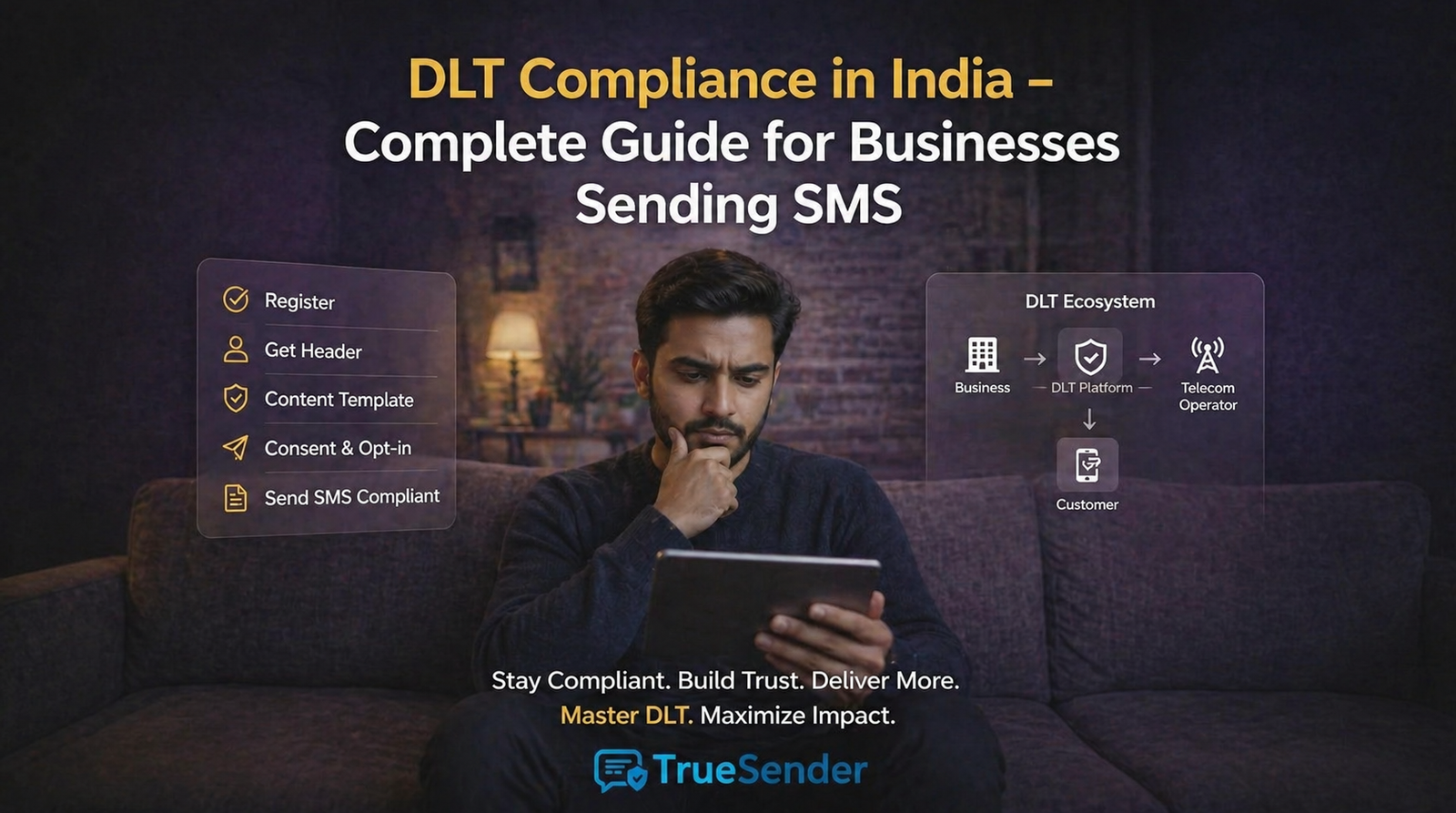
If your business sends promotional or transactional SMS in India, DLT compliance India is not optional - it’s mandatory. Introduced by TRAI (Telecom Regulatory Authority of India), the Distributed Ledger Technology (DLT) framework ensures transparency, reduces spam, and protects consumers from fraud.
But for many businesses, the process can feel complex: registration,
headers, templates, scrubbing, audits - where do you start?
This guide breaks down TRAI SMS rules in simple terms and
explains how to register DLT headers, submit templates, and stay
compliant without confusion.
What is DLT Compliance in India?
DLT compliance refers to
following TRAI’s regulations for sending commercial SMS using registered sender
IDs, approved templates, and verified consent.
Simple definition:
DLT is a blockchain-based system where all SMS communication records are
securely stored and verified to prevent spam and misuse.
Why DLT Compliance is Important for Businesses
Ignoring compliance can lead to serious consequences.
Key benefits of DLT compliance:
- Prevents SMS blocking by telecom operators
- Builds customer trust and brand credibility
- Reduces spam complaints
- Ensures legal and regulatory safety
- Improves SMS delivery rates
Non-compliance can result in:
- Message failures
- Heavy penalties
- Blacklisting of sender IDs
Key Components of
TRAI SMS Rules
To understand DLT compliance India, you need to know these core
elements:
1. Principal Entity
(PE)
Your business must register as a Principal Entity on a DLT
platform.
2. Sender ID
(Header)
A unique 6-character ID (like VK-BANK or AD-STORE) used to send SMS.
3. Message
Templates
Pre-approved SMS formats that cannot be altered beyond defined
variables.
4. Consent
Management
Proof that customers have agreed to receive messages.
5. Scrubbing
Process
A filtering system that checks customer preferences (DND/non-DND).
Step-by-Step Guide to DLT Registration in India
Here’s a clear, actionable process for businesses.
Step 1: Choose a DLT Platform
Register on any authorized telecom operator portal:
- Jio
- Airtel
- Vodafone Idea (Vi)
- BSNL
Tip: Choose one platform, but your data syncs across all.
Step 2: Register as Principal Entity (PE)
Submit business details:
- Company name
- PAN number
- GST certificate
- Address proof
Approval usually takes 1–3 working days.
Step 3: Add Authorized Signatories
Provide details of individuals who will manage SMS communication:
- Name
- Mobile number
- Email ID
Step 4: How to Register DLT Headers (Sender IDs)
This is a critical step in how to register DLT headers.
Types of headers:
- Promotional headers (random
numeric IDs)
- Transactional headers (linked to
your brand name)
Process:
- Submit header request
- Provide brand justification
- Wait for operator approval
Example:
- Approved header: “HDFCBK”
- Used for banking alerts
Step 5: Create and Approve SMS Templates
Every SMS must match a pre-approved template.
Template types:
- Transactional (OTP, alerts)
- Service-related messages
- Promotional messages
Example template:
“Dear {#var#}, your OTP is {#var#}. Do not share it.”
Important rules:
- No deviation from approved structure
- Variables must be clearly defined
- URLs must be whitelisted
Step 6: Consent Upload and Management
Businesses must prove that users opted in.
Ways to collect consent:
- Website forms
- Mobile apps
- Offline forms
Upload consent records to the DLT system for verification.
Step 7: Scrubbing and Message Flow
Before delivery:
- Numbers are checked against DND preferences
- Templates are matched
- Headers are verified
Only compliant messages are delivered.
Common Mistakes Businesses Make
Even compliant businesses sometimes face issues.
Avoid these errors:
- Sending messages without approved templates
- Using unregistered sender IDs
- Ignoring consent requirements
- Modifying templates dynamically
- Using unauthorized SMS gateways
These mistakes can lead to message rejection or penalties.
Real-World Example
A fintech startup launches SMS campaigns without proper DLT
registration.
Result:
- Messages fail to deliver
- Customers report spam
- Telecom operator blocks the sender
After completing DLT compliance India, including header
registration and template approval, their delivery rate improves significantly.
How TrueSender Supports SMS Ecosystem
While businesses focus on compliance, end-users also need protection.
TrueSender helps users:
- Identify spam SMS
- Detect suspicious sender behavior
- Avoid phishing attempts
This creates a safer ecosystem where both businesses and customers
benefit.
Best Practices for DLT Compliance
Stay ahead with these practical tips:
- Audit your SMS activity regularly
- Keep templates updated and relevant
- Monitor delivery reports and failures
- Train your team on TRAI SMS rules
- Work with verified SMS providers only
DLT Compliance Checklist (Quick View)
Use this checklist for quick reference:
- ? Registered as
Principal Entity
- ? Approved
sender IDs (headers)
- ? Verified SMS
templates
- ? Customer
consent records
- ? Active
scrubbing process
- ? Secure SMS
gateway integration
Why DLT Compliance is a Long-Term Investment
DLT is not just about rules - it’s about trust.
Businesses that follow compliance:
- Build long-term customer relationships
- Avoid legal risks
- Improve communication efficiency
In a market where SMS is still a powerful channel, compliance gives you
a competitive edge.
Conclusion
DLT compliance India is
essential for any business sending SMS. While the process may seem technical at
first, following the right steps - registration, header approval, template
submission, and consent management - makes it manageable and effective.
By aligning with TRAI SMS rules and understanding how to
register DLT headers, businesses can ensure smooth communication, better
delivery rates, and stronger customer trust.
Combine compliance with smart tools and user awareness platforms like TrueSender, and you create a secure, reliable messaging experience for everyone