
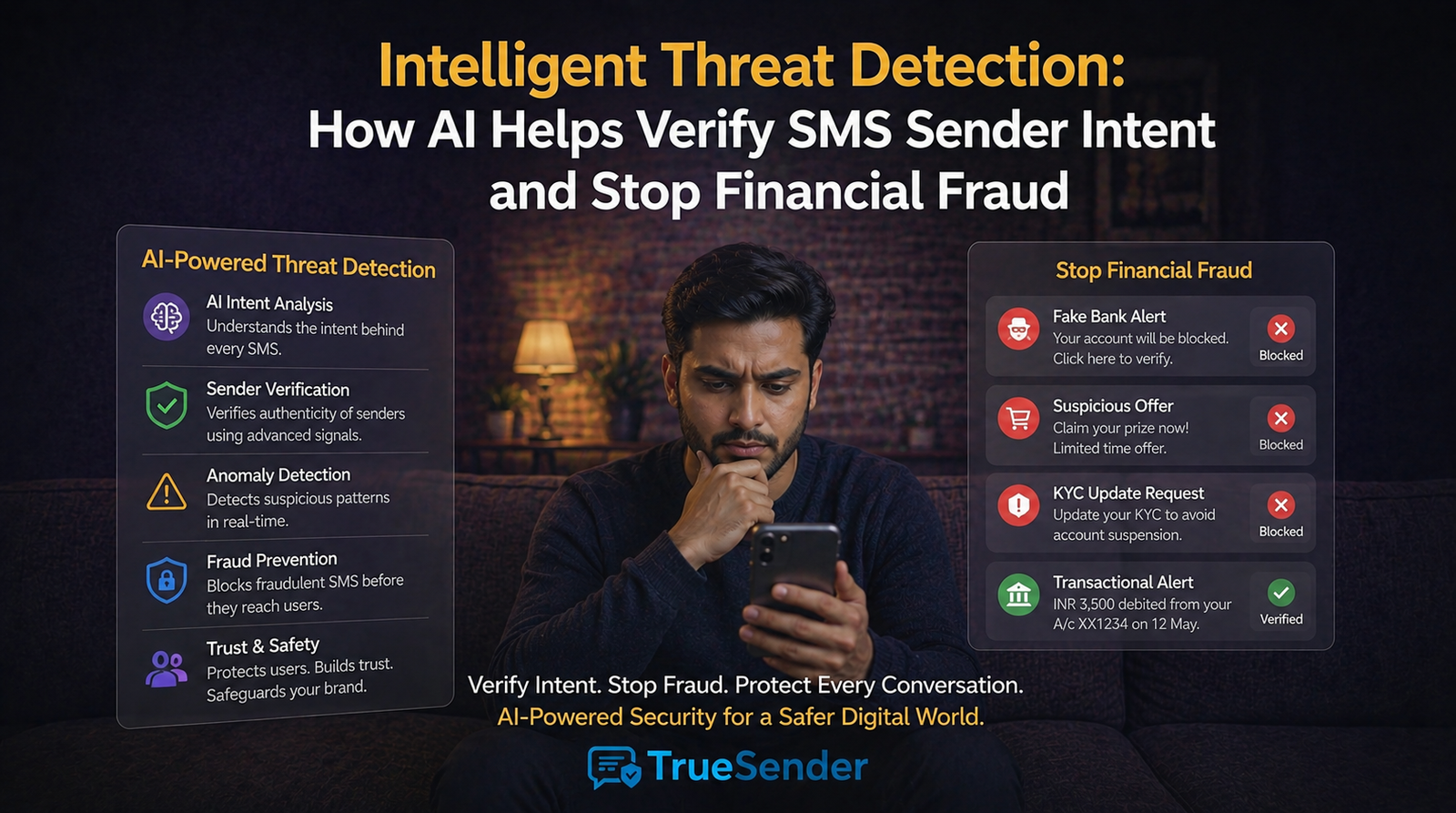
SMS fraud has become far more sophisticated than traditional spam.
Modern scammers no longer rely on random messages - they impersonate trusted
brands, exploit human emotions, and use carefully crafted social engineering
tactics to steal money and sensitive information.
This is why simply checking the sender name is no longer enough.
Businesses and consumers need technology that can verify SMS sender
authenticity, analyze message intent, and identify hidden threats before
users interact with them.
Intelligent Threat Detection is an
advanced AI-powered security layer that goes beyond sender verification. It
examines the content, context, and intent of SMS messages to identify fraud,
phishing attempts, malicious links, and financial scams in real time.
In this guide, we'll explore how Intelligent Threat Detection, Smart
Sender Identity, and AI-driven fraud prevention work together to create a
safer messaging experience.
What Is Intelligent Threat Detection?
Intelligent Threat Detection is an
AI-powered security system that analyzes SMS content to identify suspicious
behavior, fraudulent intent, phishing attacks, and social engineering tactics.
Unlike traditional spam filters that rely on keyword matching, Intelligent
Threat Detection evaluates:
- Message intent
- Behavioral patterns
- Sender reputation
- URL safety
- Fraud indicators
- Contextual anomalies
Simple Definition
If Smart Sender Identity verifies who sent the message, Intelligent
Threat Detection determines what the sender wants you to do and whether that
action is safe.
This additional layer of analysis helps users make safer decisions when
interacting with SMS messages.
Why Traditional SMS Security Is No Longer Enough
Many SMS filtering systems focus primarily on:
- Sender IDs
- Known spam databases
- Blocked phone numbers
- Basic keyword detection
While useful, these methods often fail against modern fraud tactics.
Scammers now:
- Mimic trusted organizations
- Use convincing sender identities
- Create urgency and fear
- Offer unrealistic rewards
- Redirect users to phishing websites
- Exploit emotional decision-making
As a result, many malicious messages appear legitimate at first glance.
This is where Intelligent Threat Detection becomes essential.
Common Financial Scams Detected by AI
1. Loan Approval
Scams
Fraudsters often promise instant loan approvals with minimal
documentation.
Example SMS
"Congratulations! Your ?10 lakh loan has been approved. Pay ?2,000
processing charges immediately to release funds."
Risk Indicators
- Advance payment request
- Unrealistic approval process
- Financial urgency
- Suspicious payment links
AI identifies these signals and flags the message as a potential fraud
attempt.
2. Investment Fraud
Messages
Investment scams frequently promise unrealistic profits to lure victims.
Example SMS
"Earn 20% guaranteed daily returns from Tata Stocks. Join our VIP
WhatsApp investment group now."
Warning Signs
- Guaranteed profits
- Unrealistic returns
- External messaging redirection
- Social engineering tactics
Legitimate financial institutions rarely make such promises.
3. Insurance
Renewal Scams
Scammers often use fear-based messaging to force immediate action.
Example SMS
"URGENT: Your insurance policy expires tonight. Renew immediately
to avoid penalties."
Threat Indicators
- Artificial urgency
- Fear-driven messaging
- Suspicious payment links
- Domain impersonation
AI detects coercive language patterns and warns users before
interaction.
How Intelligent Threat Detection Works
Modern solutions such as TrueSender use a privacy-focused
architecture designed to protect users while maintaining security.
Instead of uploading personal conversations to external servers,
analysis happens directly on the device whenever possible.
Step 1: Smart
Sender Identity Verification
Before analyzing content, the system first performs Smart Sender
Identity verification.
This process:
- Verifies sender legitimacy
- Checks approved SMS headers
- Validates sender reputation
- Identifies spoofed identities
This answers the first security question:
"Who sent this
message?"
However, a trusted-looking sender doesn't always guarantee a safe
message.
Step 2: Intent
Correlation Engine
The next step is understanding message intent.
Using Natural Language Processing (NLP), the AI identifies whether a
message aims to:
- Inform
- Authenticate (OTP)
- Promote
- Request payment
- Create urgency
- Manipulate behavior
The engine then compares the detected intent against expected behavior
patterns for that sender category.
Example
A bank normally sends:
- OTP notifications
- Transaction alerts
- Account updates
If a message suddenly requests cryptocurrency payments or advance fees,
the AI recognizes this as unusual behavior.
This "out-of-character" analysis helps identify sophisticated
fraud attempts.
Step 3: Forensic
Link Scanner
Links are among the most dangerous elements in SMS phishing attacks.
The Forensic Link Scanner examines URLs locally to identify:
- Typosquatting domains
- Fake websites
- Brand impersonation
- Suspicious redirects
- Domain inconsistencies
Example
Legitimate domain:
licindia.in
Fake lookalike:
li-india.com
While the difference appears small, it may lead users to a fraudulent
website.
AI detects these structural anomalies before users click.
Step 4: Dynamic
Heuristic Scoring
Every message receives a risk assessment based on multiple security
signals.
The system evaluates:
- Sender trust level
- Message intent
- Link safety
- Behavioral anomalies
- Historical patterns
These factors generate a Fraud Probability Score.
Messages exceeding predefined risk thresholds may be:
- Flagged
- Silenced
- Restricted
- Displayed with warning overlays
This prevents users from accidentally engaging with dangerous content.
Step 5:
Community-Based Threat Intelligence
Security improves when users contribute to collective protection.
Through opt-in reporting systems, users can voluntarily report confirmed
scams.
Benefits include:
- Faster threat recognition
- Detection of emerging fraud campaigns
- Improved AI learning models
- Better protection against new attack patterns
Importantly, participation remains voluntary and privacy-focused.
Key Benefits of Intelligent Threat Detection
Intent-Based
Protection
Instead of searching for specific spam words, AI understands what the
sender is attempting to achieve.
This improves detection accuracy against evolving scams.
Privacy-First
Security
Sensitive message content remains on the device whenever possible.
This reduces data exposure while maintaining effective threat analysis.
Real-Time Fraud
Prevention
Threats are identified before users click links, share information, or
make payments.
Better SMS Trust
When combined with Verify SMS Sender technology and Smart Sender Identity, users gain confidence in legitimate communications.
Reduced Decision
Fatigue
Users no longer need to manually evaluate every suspicious message.
The system performs risk assessment automatically and highlights genuine
concerns.
Best Practices for SMS Security
Whether you're a business or an individual user, these practices improve
protection:
Always:
- Verify sender identity
- Check URLs carefully
- Avoid clicking unknown links
- Never share OTPs
- Report suspicious messages
- Use trusted security applications
Businesses Should:
- Register verified SMS headers
- Follow DLT compliance requirements
- Monitor SMS campaigns regularly
- Educate customers about fraud risks
- Use intelligent threat monitoring tools
Why Intelligent Threat Detection Matters for the Future
Financial fraud continues to evolve faster than traditional spam filters
can adapt.
Attackers increasingly use:
- AI-generated scams
- Personalized phishing
- Sender spoofing
- Social engineering
- Fake financial offers
As threats become more sophisticated, security systems must evolv