
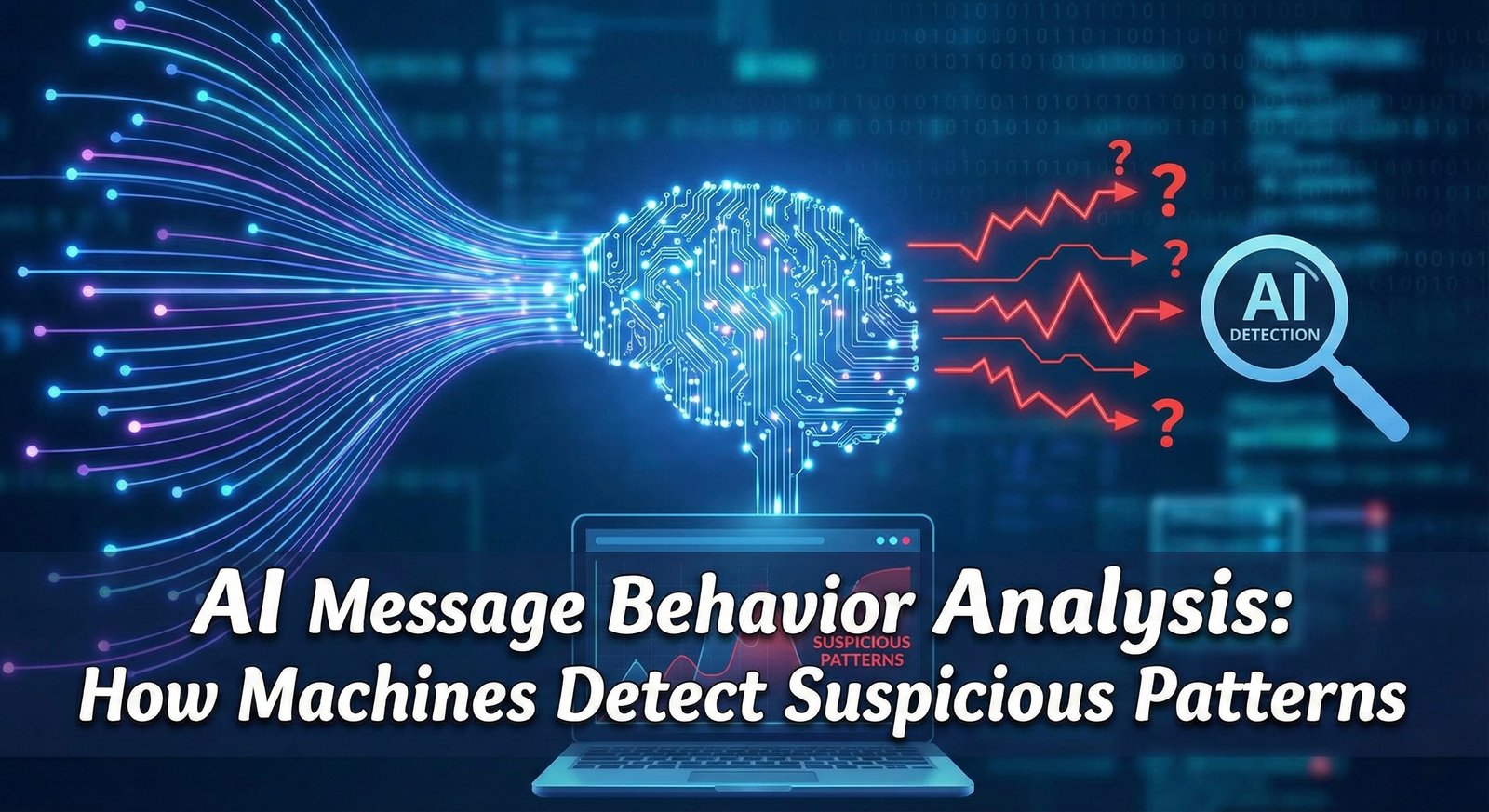
Every SMS you receive follows a pattern, of who sent, the time it gets sent, and contains what. But when scammers try to imitate some trusted senders, those patterns tend to break subtly. That's where AI message behavior analysis fits in.
Artificial Intelligence learns through billions of legitimate and fraudulent messages about suspicious communication patterns. Understanding how messages "behave," AI can spot scams, phishing attempts, and spam before users even open them.
Let's see how this state-of-the-art AI technology works behind the scenes.
What Is Message Behavior Analysis?
Message behavior analysis is an AI-driven technique that examines the form, time, and content of messages for abnormal behavior.
AI seeks:
Anomalous sender activity, such as a new number sending hundreds of messages
Cyclic patterns or spam frequency
Fake keywords or mismatched context
Irregular timing of or mass bursts of messaging
By detecting such deviations, AI picks up suspect senders and messages that may not get filtered out by traditional filters.
How AI Learns Normal vs. Abnormal Message Patterns
AI models are being trained on a large dataset of valid and fraudulent SMS messages.
Here's how AI differentiates between safe and risky patterns:
Content Classification: It identifies the topics, tones, and language patterns of the content.
Profiling of Sender: Provides a trust score for each sender based on previous message history.
Temporal analysis: It detects anomalies in the timing or frequency of messages.
Anomaly detection and clustering: Flags messages that behave differently from known safe patterns.
This, in turn, enables continuous learning of AI, which evolves it-make detection smarter with each new message analyzed.
Key AI Techniques Used in Behavior Analysis
Natural Language Processing (NLP): helps the AI understand what is typed and the meaning of the message, along with the tone being portrayed.
Machine Learning Classification: This categorizes messages as safe, suspicious, and spam.
Pattern Recognition Algorithms: It can detect subtle changes to structure or metadata associated with the sender.
Predictive Analytics: It anticipates fraud methods of the future by emerging patterns.
These techniques put together empower AI to even find zero-day scams-those which are completely new and have never been seen before.
Real-World Example - TrueSender’s Behavior Analysis in Action
AI at TrueSender performs continuous monitoring of SMS traffic to identify patterns of suspicious behavior in real time.
Our AI system:
Monitors Message Frequency and Timing Anomalies
Detection of impersonation or spoofing attempts
Flags new or unverified senders
Blocks mass scam campaigns before they spread
This proactive approach ensures that users stay safe, with no need to worry about any threats, hidden or otherwise.
Why Behavior Analysis Is the Future of SMS Security
Traditional spam filters depend on static rules or keyword lists to filter out spam; cybercriminals are changing their tactics non-stop.
AI behavior analysis automatically adapts, providing:
Dynamic threat detection instead of fixed rules
Instant fraud response for real-time security
Continuous improvement through machine learning feedback
That's why AI behavior analysis isn't just an upgrade to but a revolution in mobile message protection.
Conclusion
AI-powered message behaviour analysis enables machines to think like security experts in their ability to identify any suspicious activity before it may become a problem. Through studying patterns of messages, AI can predict, detect, and block fraudulent communications instantly. With TrueSender's AI-driven behaviour analysis, your inbox is about to get a whole lot smarter, safer, and scam-free around the clock.